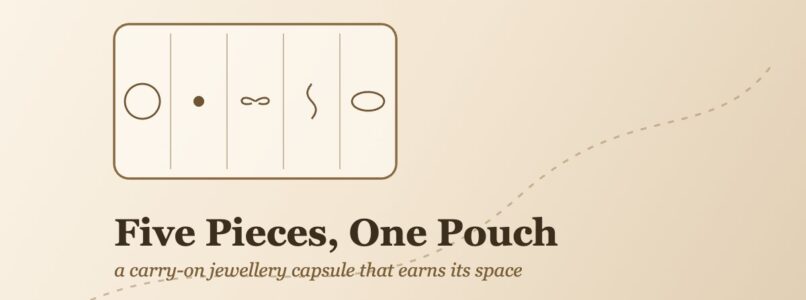
Every packing list I have ever read treats jewellery as an afterthought, which is how people end up with a tangled pouch containing nine earrings, one of which has a partner somewhere in a different country. The problem is not quantity. It is that the pieces were chosen individually rather than as a set, so none of them quite work together and most stay in the bag.
Five pieces is the right number for a trip of up to a fortnight. Not because five is magic, but because it is enough to cover the range from airport to a decent restaurant while still fitting in something the size of a sunglasses case.
The constraints that shape the choice
Travel is harder on jewellery than daily life at home, in specific ways worth designing around.
- Loss is the dominant risk. Not theft, mostly. Small items left in hotel bathrooms, dropped on aircraft floors, and removed at security then forgotten. Anything irreplaceable should stay home. This is the one rule I would not bend.
- Sleep happens in transit. On long-haul you will doze in whatever you are wearing, so anything with a sharp profile or a dangling element is going to hurt or snag.
- Climate shifts. Heat, humidity, sunscreen, salt water and chlorine all accelerate tarnish and degrade plating faster than a Sydney winter does.
- You will repeat outfits. The same four or five garments cycle through the whole trip, so jewellery does most of the work of making them look deliberate.
The five pieces
1. A pair of small studs you never take off
This is the workhorse. It goes through security, sleeps on planes, survives swimming, and requires no thought. Small and flat-backed is the requirement, because anything with a profile becomes unbearable against a headrest.
A quiet decorative front is what separates this from a plain ball stud and lets it carry an evening as well as a morning. Small bow and knot shapes do this particularly well, reading as finished rather than minimal without adding bulk: https://www.lavanajewellery.com.au/products/petite-bow-stud-earrings-gold
Buy the studs before the trip and wear them for a week at home first. Discovering on day two in a foreign city that a metal irritates your ears is a miserable way to lose a piece from a five-item capsule.
2. A pair of medium hoops
The single biggest visual shift available for the least space. Hoops change the register of a plain t-shirt completely, which is precisely what a repeated outfit needs. Medium rather than large, because large hoops catch on seatbelts, scarves and bag straps, and because medium survives being packed loose.
3. One fine chain
Worn, not packed. A chain in a bag will tangle regardless of your intentions, so the solution is to put it on at home and leave it on. A fine chain sits under everything, needs no maintenance, and fills the neckline of a shirt without competing with anything.
4. One pendant on its own chain
The piece that does evening. Separate chain rather than threading it onto the fine one, so you can wear both at once and get a layered look without packing a third necklace. This is where a small amount of visual interest is worth the space, because it is the only piece doing that job.
5. One rigid bracelet or bangle
Rigid, specifically. A bangle has no clasp to fail, nothing to tangle, and slides onto a wrist in the dark. Chain bracelets are the most commonly lost travel item, because the clasp opens against a sleeve and you do not notice until hours later.
Packing it so it survives
- Wear the chains. Anything with a clasp goes on your body, not in the bag. This solves tangling entirely.
- One compartment per pair. A roll with small pockets, or failing that, individual zip bags. Earrings loose in a shared pouch lose partners.
- Pair up studs through a button. Push both posts through a shirt button’s holes and fasten the backs. They cannot separate.
- Carry-on only, always. Checked luggage goes missing, and the pouch weighs nothing.
- A soft pouch, not a hard box. Boxes are bulky and make an obvious target in a hotel room. A flat pouch disappears into a packing cube.
- Anti-tarnish strips. Two small strips in the pouch do a genuine amount of work in humid climates and cost almost nothing.
Keeping it intact while you travel
The habits are duller than the packing but matter more. Take jewellery off before sunscreen rather than after, because sunscreen is the most reliable way to dull a finish over a fortnight. Rinse with fresh water after the sea or a pool and dry properly. Never leave a piece on a bathroom shelf, which is where hotel losses overwhelmingly happen; put it back in the pouch and the pouch in the same pocket of the same bag, every time.
One more thing: photograph the five pieces laid out before you leave. It takes ten seconds, and it is both a packing checklist and, in the unlikely event you need it, a record for a travel insurance claim.
Frequently asked questions
Can you wear jewellery through airport security?
Small amounts of everyday jewellery almost never trigger a walk-through scanner, so studs, a fine chain and a bangle can stay on. Heavy or bulky pieces may prompt a secondary check. Wearing clasped items rather than packing them is the better approach either way, since it prevents tangling.
How do you keep necklaces from tangling when travelling?
Wear them. Anything with a clasp should be on your body rather than in a bag, which eliminates the problem entirely. For necklaces you must pack, thread each chain through a drinking straw or fasten it around a card before storing it flat.
Should you take good jewellery on holiday?
Leave anything irreplaceable at home. The main travel risk is loss rather than theft, and sentimental pieces cannot be replaced by insurance. Durable everyday pieces in solid metal travel well because they tolerate water, heat and sunscreen better than plated items.